
Synapse to Fabric · DP-700 certified

Microsoft Fabric Migration Architect.

I move enterprise data platforms from Synapse to Microsoft Fabric, and I look for the failures that never throw an error. On one programme, platform cost fell by around 65%. The Migration Playbook is the set of checks I run before moving a single workload.

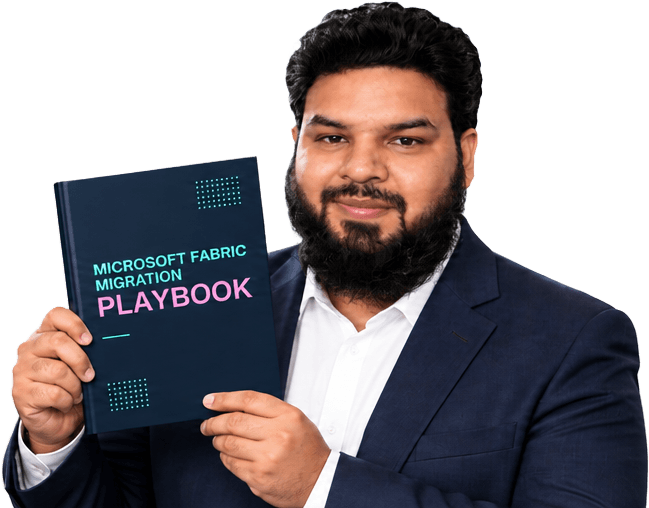
Fayyaz Farooq holding the Microsoft Fabric Migration Playbook
~65%
lower platform cost on one programme
60%
better processing efficiency
70%
shorter incident response
DP-700
Fabric Data Engineer Associate
1,000+
people trained
migration.logsynapse → fabric
  1. 21 source systems landed in OneLake
  2. pipelines green, notebooks green
  3. collation joins return fewer rows
  4. sql endpoint report shows old numbers
  5. direct lake fell back to DirectQuery
  6. capacity 250%, metrics app won’t open
  7. ownership link ran on a personal account
  8. platform cost down ~65%
  9. 10 issues, 10 fixes, all written down
10 lessons · all anonymisedRead them ↓

01 Field notes

Ten things the migration docs don’t warn you about.

Every one of these hit us in production. Most never threw an error. They returned believable numbers, or a bigger bill. Open any of them. The first one comes with the fix.

01Joins quietly return fewer rows.Warehouse

What happened

The Fabric Warehouse is case-sensitive by default. Our SQL Server sources weren’t. ‘Karachi’ and ‘KARACHI’ stopped matching, and nothing threw an error.

The fix

Pick the collation when you create the warehouse, because you can’t simply change it later. Compare row counts table by table after each load. Where business keys mix case, normalise them with UPPER() or LOWER().

02Every pipeline was green. The report still lied.SQL endpoint

What happened

The semantic model refreshed before the SQL analytics endpoint had synced the new Delta files. The numbers on screen were from the previous load, at 6 pm on a Friday.

03Direct Lake fell back to DirectQuery, and nobody noticed.Power BI

What happened

SQL views, RLS on the endpoint, breached guardrails or memory pressure all push Direct Lake back to DirectQuery. The reports still load. Just slower, and nobody tells you why.

04An AI-rewritten loop froze the capacity for two hours.T-SQL

What happened

Fabric Warehouse doesn’t support recursive CTEs. A bill-of-materials explosion was rewritten by AI as a WHILE loop. It never finished, and it pushed capacity past 200%.

05At 250%, we couldn’t even open the metrics app.Capacity

What happened

Our F256 hit 250% utilisation and everyone was locked out. The Capacity Metrics app lived on the same capacity, so the one tool we needed was throttled too.

06We sized capacity off a calm demo.Capacity

What happened

The proof of concept ran one workload at a time. In production, a single heavy Spark job starved Power BI in week two.

07Our Synapse monitoring didn’t come with us.Monitoring

What happened

The Grafana dashboards on Azure Monitor stayed behind. The Capacity Metrics app keeps 14 days, so ‘what did this cost us last quarter?’ had no answer inside the product.

08Finance went stale because one person went on leave.Ownership

What happened

The Dataverse link into Fabric was set up under a personal account. While that person was away, the sync stopped and finance reporting quietly went stale.

09Our most expensive pipeline was one nobody remembered creating.Cost

What happened

Once we listed every job, plenty had no owner. Old copies, duplicate loads, refreshes feeding reports nobody opened. All of it burned capacity.

10The data moved. The business didn’t.Adoption

What happened

People still trusted a ten-year-old Excel file more than the new reports. So both platforms kept running, and we paid for both.

Early access · chapter 1 out now

Microsoft Fabric Migration Playbook.

The 10 checks I run before moving a single workload from Synapse to Fabric. How to check each one, and the fix.

  • The 10-point pre-migration checklist, with a fix for each
  • Fresh PySpark and T-SQL snippets to run the checks
  • A capacity baseline sheet, so you size for the peak and not the demo
Get the Playbook, $29
The Microsoft Fabric Migration Playbook, chapter 1, 10 checks before you migrate
The most dangerous migration bugs don’t throw errors. They return believable numbers.
From my field notes

02 Learn with me

Learn it from someone who’s already paid for the mistakes.

A free 30-day plan, a call, a workshop, a calculator or a weekly post. Start wherever you are.

FreeWeek 1 out now

Microsoft Fabric in 30 days.

You already know data engineering. This is the Fabric part. About 45 to 60 minutes a day, hands-on in a trial workspace, with the Microsoft Learn pages for each day.

  • FoundationsWeek 1 · out now
  • Ingest and transformWeek 2
  • Serve and real-timeWeek 3
  • Run it like production, then a capstoneWeek 4
1:1 callsOnline

Talk it through, one to one.

For engineers preparing for DP-700, a new role, or their first Fabric project. Bring the real question. You’ll get a straight answer.

  • DP-700 and career call30 minA study plan, what the exam actually tests, and an honest read on where you stand.
  • CV and LinkedIn reviewReviewHow your CV and profile read to a hiring manager, and what to change first.
  • Microsoft Fabric data engineering mock interview45 minSQL, PySpark and a design round, with feedback straight after.

Good things to bring

Your DP-700 study planMoving from SQL Server to FabricSpark or T-SQL?Your first data engineering roleSizing a capacityA system design question you got stuck on
WaitlistLive workshop

Microsoft Fabric Migration, without the rework.

Two live sessions for teams on Synapse who know Fabric is next and would rather skip the expensive lessons.

2 live sessions15 seatsOnline
FreeNo signup

Fabric capacity calculator.

Pay-as-you-go or reserved? Put in your real uptime and see where the break-even sits, plus what pausing saves.

Weekly

Fabric changes that hit cost and reliability.

One field note a week. What changed in Fabric, what it breaks, and what I’d check today. Get it by email, or follow along with 3,900+ people on LinkedIn.

03 Rules of thumb

What I’d tell you before your kickoff call.

Each one came out of a real project, usually the hard way.

01Migration

Migration is not translation.

02Architecture

The convenient setup and the fragile setup look identical on day one.

03Data quality

If your data was a mess before the migration, Fabric gives you a faster, prettier mess.

04Cost

Your architecture is now part of your billing model.

05Power BI

Nobody actually wants Direct Lake. They want fast reports.

06Cost

Small defaults get expensive fast.

07Production

This won’t appear on your clean architecture diagram. It will appear in production.

08Cost

The fastest query is the one you delete. The cheapest pipeline is the one you never rebuild.

09Governance

You can mandate governance with a policy. You can’t mandate trust.

04 About

Hired as a data engineer. Still one, mostly.

Role
Microsoft Fabric Migration Architect. Lead Data Engineer and Managing Consultant by title.
Based in
Karachi, Pakistan
In data since
2017. Cloud since 2020.
Certified
Microsoft Certified: Fabric Data Engineer Associate (DP-700), Sep 2026. Verify ↗
Daily stack
Fabric, Synapse, Purview, Databricks, PySpark, T-SQL, Power BI
Also
Data and AI architecture, BigQuery, Dataproc, GenAI, marketing-mix models

One last thing

Go check your collation.

Seriously. Then come back and tell me what you found. My inbox is open.

My best work looks like nothing happened.

1:1 calls

Call booking opens in December 2026.

Join the email list and I’ll send you the booking link when it opens.